Current Offerings -- Greek Coins (Page 1 of 3)
    Current Offerings              

|
Go to ==>>
|
 
Special Offer of
|
|
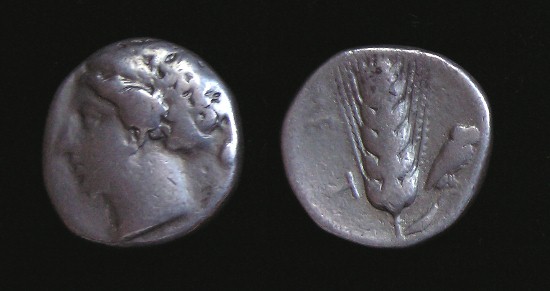
(Double click for enlarged photo)
|
#11840: Gold Stater – 1st Century BC, Alexander the Great (353 - 323 BC) Minted under Mithradites 88-86 BC or Burtus (Assassin of Julius Caesar) - Read below Istros Mint ! Historical Context: This GOLD
STATER may have been minted by BRUTUS, the famous assassin of JULIUS
CAESAR - Ref. Harlen Berk. After the assassination of Caesar, Brutus
retreated to Obv: Alexander wearing Horn of Ammon
|
|
 |
#11839: Gold Stater – 1st Century BC, Alexander the Great (353 - 323 BC) Minted under Mithradites 88-86 BC or Burtus (Assassin of Julius Caesar) - Read below Tonis Mint ! Historical Context: This GOLD
STATER may have been minted by BRUTUS, the famous assassin of JULIUS
CAESAR - Ref. Harlen Berk. After the assassination of Caesar, Brutus
retreated to Obv: Alexander wearing Horn of Ammon
|
|
|
|
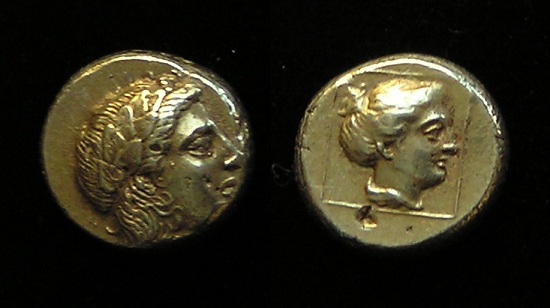
#11175: Electrum (GOLD/SILVER Alloy) Hecke - 4th
Century BC, Island of Lesbos Historical Context: This coin was minted on the Island of Lesbos in the 4th Century BC. This is shortly after the time of Sappho, the poet, and widely acknowledged as the first lesbian known to history. Lesbos is a Greek island located in the northeastern Aegean Sea. It is separated from Turkey by the narrow Mytilini Strait. Lesbos was founded in the 11th century BC by the family Penthilidae, who arrived from Thessaly, and ruled the city-state until a popular revolt (590–580 BC) led by Pittacus of Mytilene ended their rule. For a short period it was a member of the Athenian confederacy, its apostasy from which is described in a stirring chapter of Thucydides' history of the Peloponnesian War. In Hellenistic times, the island belonged to various Successor kingdoms until 79 BC when it passed into Roman hands. According to Classical Greek mythology, Lesbos was the patron god of the island. Macar was reputedly the first king whose many daughters bequeathed their names to some of the present larger towns. In Classical myth his sister, Canace, was killed to have him made king. The place names with female origins are likely to be much earlier settlements named after local goddesses, who were replaced by gods. The word lesbian derives from the poems of Sappho, who was born in Lesbos and who wrote with powerful emotional content directed toward other females. The Alexandrians included her in the list of nine lyric poets. Her birth was sometime between 630 and 612 BCE, and it is said that she died around 570 BCE, but little is known for certain about her life. The bulk of her poetry, which was well-known and greatly admired throughout antiquity, has been lost, but her immense reputation has endured through surviving fragments. Obv: Apollo BUY NOW $995 plus shipping
|
|
 |
#11356: Electrum (GOLD/SILVER Alloy) Hecke - 6th - 5th
Century BC, Island of Lesbos Historical Context: See above for discussion of Lesbos Obv: Lion Roaring SOLD $995 plus shipping
|
|
 |
#11712: ELECTRUM (GOLD/SILVER ALLOY) STATER - 310-270 BC, Carthage Historical Context: This coin was
minted in
Carthage, Zeugitana between 310 to 270 BC. Carthage was a coastal
region of North Africa just across the Mediterranean Sea from Silicy.
Obv: Tanit (Patron Goddess of Carthage),
wearing a wreath of grain-ears, triple-pendant, earring and pendant
necklace BUY NOW $2,795 plus shipping
|
|
(Double click for enlarged photo)
|
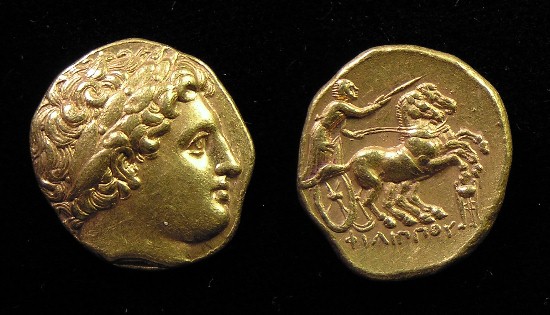
#8564: GOLD STATER - 340 BC, Minted by Philip II, Apollo with Alexander's Facial Features !! Historical Context: This coin was minted by the MACEDONIAN EMPIRE during the reign of Philip II, father of Alexander the Great, around 340 BC. Obv: Alexander the Great as Apollo SOLD $2795 plus shipping
|
|
|
|
||
|
(Double click for enlarged photo) |
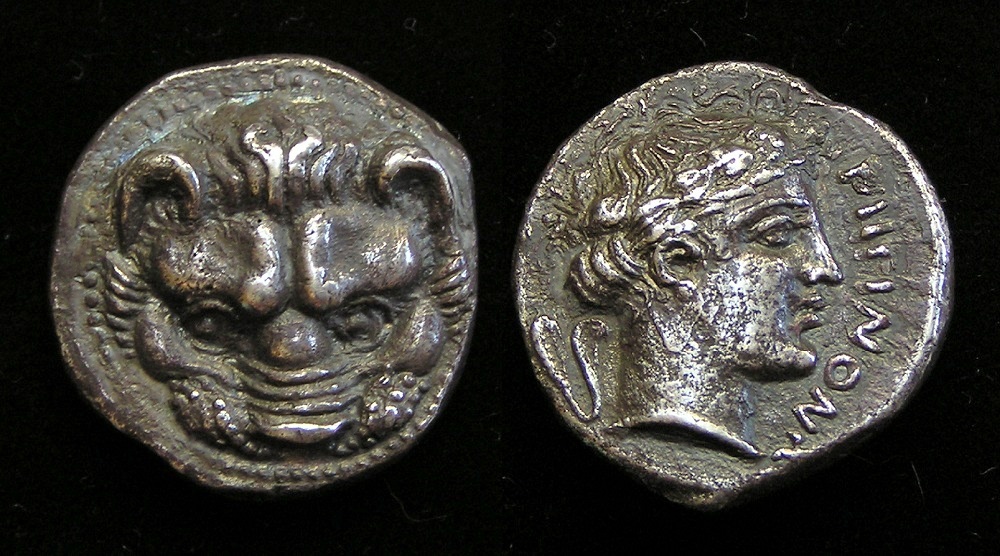
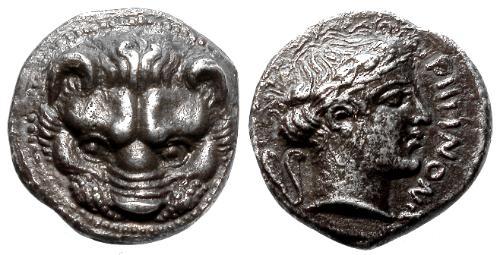
#10635: SILVER Tetradrachm- 415-387 BC Bruttium, Rhegion RARE and Highly Collectable Type Historical Context: This coin was minted Bruttium, Rhegion, located on the toe of the Italian peninsula and is separated by the Strait of Messina from the island of Sicily. After Cumae, it is the second oldest Greek colony in southern Italy. The colony was settled by the inhabitants of Chalcis and Messenia in 720 BC on the site of an older settlement. This dated back to the 3rd millennium BC and was established by the Ausones. The last Ausonian ruler was the legendary king Italus (from whom the name of Italy is derived). Rhegion was one of the most important cities in Magna Grecia, reaching great economic and political power during the 5th and 6th centuries BC under the Anaxilas government. Rhegion reached great artistic and cultural heights with its philosophic Pythagorean school, as well as sculpture and poetry schools, from where came leaders such as Pythagoras of Rhegium and Ibycus. Later, Rhegion allied with Athens during the Peloponnesian War but in 387 BC, the city was taken by the Syracusans. As an independent city, Rhegium was an important ally and "socia navalis" of Rome. Then during the Imperial age it became one of the most important and flourishing cities of southern Italy because it was the seat of the "Corrector", the Governor of the "Regio II Lucania et Bruttii" (province of Lucany and Brutium). It was a noble Roman city. During the Byzantine Age, Rhegion became the capital of the "metropolis of the Byzantine possessions in southern Italy", and later capital of the Duchy of Calabria and linchpin of the Greek church in Italy. Obv: Lion's Head (Face on) ex-Old French Collection BUY NOW $7,995 plus shipping
|
|
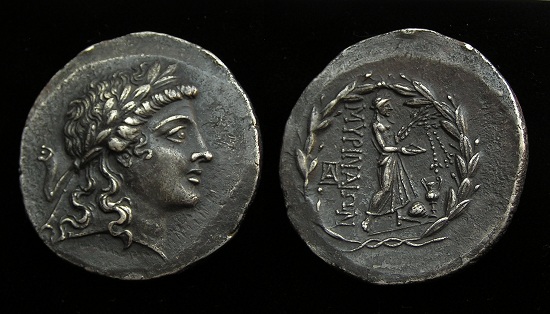 |
#11073: Silver Tetradrachm - 2nd Century BC, Myrina, Aiolis Historical Context: This coin was minted in MYRINA during the 2nd Century BC. Myrina was located north-east of Kyme (western shore of Aiolis) and was overshadowed by its more important neighbor. Myrina was believed to be of some importance during Hellenistic times. Obv: Young Apollo BUY NOW $1,495 plus shipping
|
|
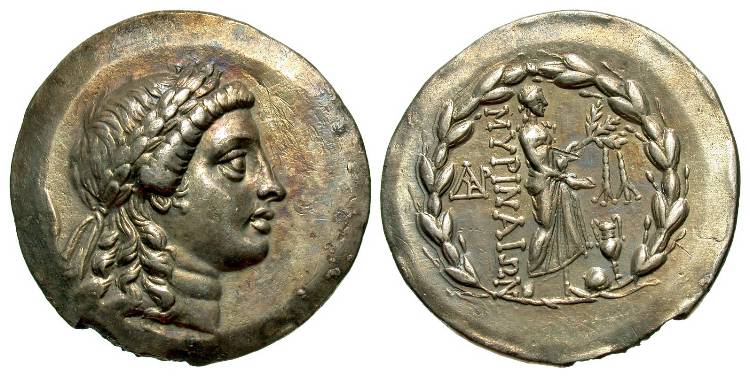 |
#11887: Silver Tetradrachm - 2nd Century BC, Myrina, Aiolis NGC Authenticity Certificate Included Historical Context: This coin was minted in MYRINA during the 2nd Century BC. Myrina was located north-east of Kyme (western shore of Aiolis) and was overshadowed by its more important neighbor. Myrina was believed to be of some importance during Hellenistic times. Obv: Young Apollo BUY NOW $1,095 plus shipping
|
|
  |
#11658: Silver Tetradrachm - 2nd Cent BC Cyme (Aeolis) Region This coin is absolutely beautiful type....One of my favorite types Historical Context:
This coin was minted in Cyme (Kyme) about the second century BC. Aeolis
was located on the western The Aeolians regarded Cyme as the largest and most important of their twelve cities, which were located on the coastline of Asia Minor (modern-day Turkey). As a result of their direct access to the sea, unlike most non-landlocked settlements of the ancient world, trade is believed to have prospered. In his Histories, Herodotus makes reference to Cyme (or Phriconis) as being one of the cities in which the rebel Lydian governor Pactyes sought refuge, following his attempted rebellion against the Persian King Cyrus the Great. about The Amazons
The eighth-century B.C. poet Homer was the first to mention the
existence of the Amazons. In the Iliad—which is set 500 years earlier,
during the Bronze or Heroic Age. Homer referred to them somewhat
cursorily as Amazons antianeirai, an ambiguous term that has
resulted in many different translations, from “antagonistic to men” to
“the equal of men.” In any case, these women were considered worthy
enough opponents for Homer’s male characters to be able to boast of
killing them.
Myth or fact, symbol or neurosis, none of the theories adequately
explained the origins of the Amazons. If these warrior women were a
figment of Greek imagination, there still remained the unanswered
question of who or what had been the inspiration for such an elaborate
fiction. Their very name was a puzzle that mystified the ancient Greeks.
They searched for clues to its origins by analyzing the etymology of
Amazones, the Greek for Amazon. The most popular explanation claimed
that Amazones was a derivation of a, “without,” and mazos,
“breasts”; another explanation suggested ama-zoosai, meaning
“living together,” or possibly ama-zoonais, “with girdles.” The
idea that Amazons cut or cauterized their right breasts in order to have
better bow control offered a kind of savage plausibility that appealed
to the Greeks.
Future generations of poets went further and gave the Amazons a fighting
role in the fall of Troy—on the side of the Trojans. Arktinos of Miletus
added a doomed romance, describing how the Greek Achilles killed the
Amazonian queen Penthesilea in hand-to-hand combat, only to fall
instantly in love with her as her helmet slipped to reveal the beautiful
face beneath. From then on, the Amazons played an indispensable role in
the foundation legends of Athens. Hercules, for example, last of the
mortals to become a god, fulfills his ninth labor by taking the magic
girdle from the Amazon queen Hippolyta.
By the mid-sixth century B.C., the foundation of Athens and the defeat
of the Amazons had become inextricably linked. The Hercules versus the
Amazons myth was adapted to include Theseus, whom the Athenians
venerated as the unifier of ancient Greece. In the new version, the
Amazons came storming after Theseus and attacked the city in a battle
known as the Attic War. It was apparently a close-run thing. According
to the first century A.D. Greek historian Plutarch, the Amazons “were no
trivial nor womanish enterprise for Theseus. For they would not have
pitched their camp within the city, nor fought hand-to-hand battles in
the neighborhood of the Pynx and the Museum, had they not mastered the
surrounding country and approached the city with impunity.” As ever,
though, Athenian bravery saved the day.
Adapted from an essay was written by Amanda Foreman for the Smithsonian
Magazine.
Obv: Amazon Cyme BUY NOW $1,295 plus shipping
|
|
 |
#11660: Silver Tetradrachm - 2nd Cent BC Cyme (Aeolis) Region This coin is absolutely beautiful type....One of my favorite types Historical Context: See above Obv: Amazon Cyme BUY NOW $895 plus shipping
|
|
|
(Double click for enlarged photo)
|
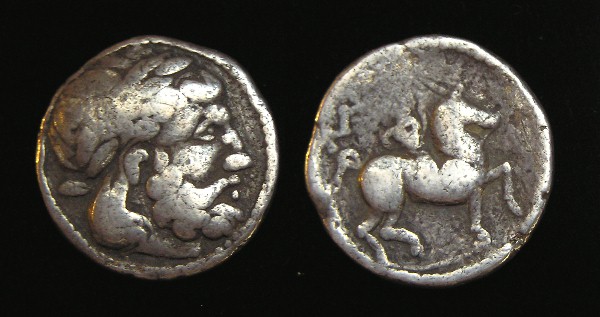
#11288: Silver Tetradrachm-340 BC, Macedonian Empire - Philip II Father of Alexander the Great !! Commemorates his Olympic Victory !! Historical Context: This coin was minted by the MACEDONIAN EMPIRE during the reign of Philip II, father of Alexander the Great, around 340 BC. The Macedonian empire was founded by Alexander I but carried forward by others including Philip II and Alexander the Great. Philip II developed the army and tactics that enabled Alexander the Great to accomplish his victories. When Philip II was young he won two Olympic equestrian victories. His coins often commemorate those victories. Obv: Philip II as Zeus SOLD $569 plus shipping
|
|
(Double click for enlarged photo) |
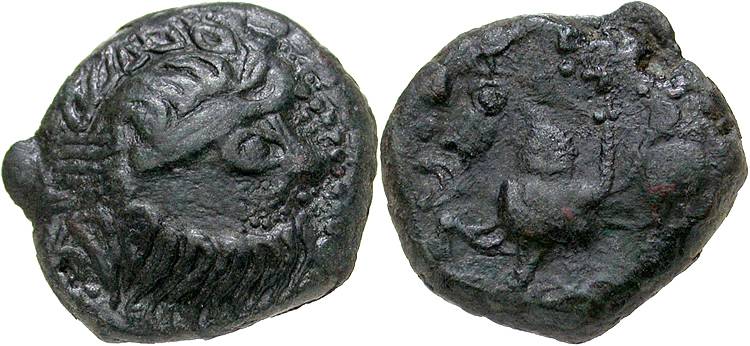
#8805: CELTIC Silver Tetradrachm-340 BC, Copy of Macedonian Empire - Philip II Father of Alexander the Great !! Commemorates his Olympic Victory !! Historical Context: See above Obv: Philip II as Zeus BUY NOW $239 plus shipping
|
|
 |
#10817: CELTIC Billon Tetradrachm-2nd
Cent BC, Copy of Macedonian Empire - Philip II Father of Alexander the Great !! Commemorates his Olympic Victory !! Historical Context: See above Obv: Philip II as Zeus BUY NOW $239 plus shipping
|
|
 |
#11358: CELTIC Silver
Stater -1st Cent BC, Copy of Greek Larissa Type Historical Context: See above Obv: Nymph - 3/4's Right face-on BUY NOW $329 plus shipping
|
|
 |
#11663: SILVER STATER - 330 BC, Bruttium (Lokroi Epizephyrioi, Italy) Highly Collectable type - High Artistic Execution Historical Context: Bruttium, also formerly known as Italia, is a region in southern Italy, forming the "toe" of the Italian Peninsula. In ancient times the name Calabria was used to refer to the southern part of Apulia, the peninsula of Salento (also known as the "heel" of Italy). Calabria was first settled by Italic Oscan-speaking tribes. Two of these tribes were the Oenotrians (roughly translated into the "vine-cultivators") and the Itali. Greek contact with the latter resulted in Calabria taking the name of the tribe and was the first region to be called Italy (Italia). Greeks settled heavily along the coast at an early date and several of their settlements, including the first Italian city called Rhégion (Reggio di Calabria), and the next ones Sybaris, Kroton (Crotone), a settlement where the mathematician Pythagoras later resided, and Lokroi (Locri), were numbered among the leading cities of Magna Graecia during the 6th and 5th centuries BC. The Greeks were conquered by the 3rd century BC by roving Oscan tribes from the north, including a branch of the Samnites called the Lucanians and an offshoot of the Lucanians called the Bruttii. The Bruttii conquered the Greek cities, established their sovereignty over present day Calabria. The Romans conquered the area in the 3rd century BC after the fierce Bruttian resistance, possibly the fiercest resistance the Romans had to face from another Italic people. At the beginning of the Roman Empire the region would form the Augustan Regio III Lucania et Bruttii of Roman Italy. Obv: Zeus
BUY NOW
$1,295 plus shipping
|
|
|
|
||
|
|
||
|
|
||
|
|
||
|
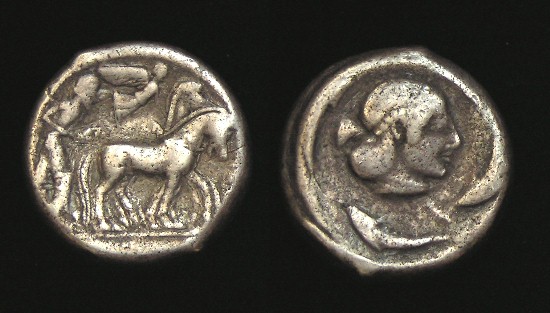
#9702: SILVER Tetradrachm - 5th
Century BC, Historical Context: This coin was
minted in Obv:
Slow Biga, Nike above SOLD $549 plus shipping
|
|
|
|
||
|
|
||
|
|
||
|
|
||
(Double click for enlarged photo) |
#11856: Tetradrachm of Athens, 5th Century BC, Historical Context: This coin was minted in Athens about mid 4th Century BC. Throughout most of the 5th century BC, after the Persian defeat, Athens ruled the Aegean world and became a great cultural and political center. The Peloponnesian War, 431-404 BC, drained Athens of her wealth, which led the way for Sparta and later the Macedonian Empire under Philip II (Father of Alexander the Great) to take control of the Greek World. Obv: Athena her helmet
adorned in front with three olive leaves SOLD $429 plus shipping
|
|
|
|
||
|
|
||
|
|
||

|
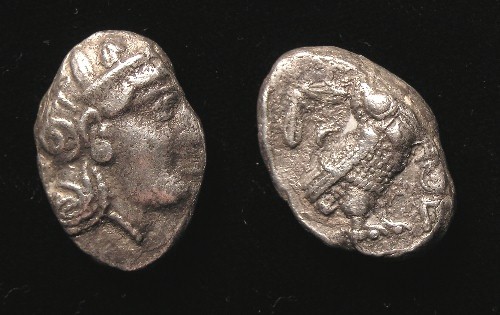
#11854: Tetradrachm of Athens, 4th Century BC, Historical Context: See above Obv: Athena her helmet
adorned in front with three olive leaves SOLD $379 plus shipping
|
|
|
#9418: Tetradrachm of Athens, 4th Century BC, Historical Context: See above Obv: Athena her helmet
adorned in front with three olive leaves SOLD $219 plus shipping
|
|
|
|
||
(Double click for enlarged photo) |
#11743:
Silver Tetradrachm - 2nd Century BC, ATHENS Historical Context: This coin was minted in Athens during the 2nd Century BC. In this era Athens was under Roman control. Throughout most of the 5th century BC, after the Persian defeat, Athens ruled the Aegean world and became a great cultural and political center. However, the Peloponnesian War, 431-404 BC, drained Athens of her wealth allowing subsequent conquests by Alexander the Great, the Seleukid Empire, and finally, the Romans. These "New Style Owl" coins are some of the most popular coins in antiquity. Obv: Athena SOLD $879 plus shipping
|
|
|
|
||
|
|
||
|
|
||
|
(Double click for enlarged photo) |
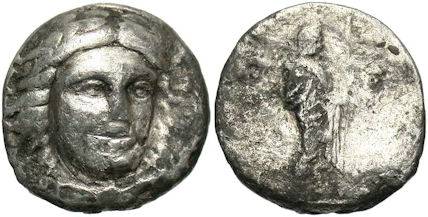
#11388: Didrachm of Pixodaros, Historical Context: As part of the Achaemenid Empire, Caria in the fourth century BC was under the rule of a family of semi-independent satraps known collectively as the Hekatomnids, named after the dynasty's founder, Hekatomnos. Born in Mylasa, Artaxerxes II appointed Hekatomnos satrap of Caria after the fall of Tissaphernes, with orders that he provide forces which would assist the Great King in his recovery of the island of Cyprus. Though there exists some doubt about Hekatomnos' loyalty to the Achaemenids, such doubts did not prevent him being given control of Miletos, one of the most important Ionian cities, certainly his in 386 BC under the terms of the King's Peace. When he died in 377 BC, Hekatomnos' son Maussollos succeeded him, soon in turn to be followed by his other sons, Hidreus and Pixodaros. Pixodarus, the youngest of the three sons of Hecatomnus, ruled 340-334 BC. Wishing to gain the blessings of the rising Macedonian Empire, Pixodarus offered his eldest daughter in marriage to his Philip's son Arrhidaeus. However, Arrhidaeus' ambitious younger brother, Alexander (later Alexander the Great) offered himself instead. Pixodarus eagerly agreed but Philip put an end to the scheme. Pixodarus died, apparently a natural death.
Obv: Laureate and draped facing bust of Apollo, slightly
turned to the right BUY NOW $1,495 plus shipping
|
|
 |
#11059: Drachm of Maussollos, Historical Context: As part of the Achaemenid Empire, Caria in the fourth century BC was under the rule of a family of semi-independent satraps known collectively as the Hekatomnids, named after the dynasty's founder, Hekatomnos. Born in Mylasa, Artaxerxes II appointed Hekatomnos satrap of Caria after the fall of Tissaphernes, with orders that he provide forces which would assist the Great King in his recovery of the island of Cyprus. Though there exists some doubt about Hekatomnos' loyalty to the Achaemenids, such doubts did not prevent him being given control of Miletos, one of the most important Ionian cities, certainly his in 386 BC under the terms of the King's Peace. When he died in 377 BC, Hekatomnos' son Maussollos succeeded him, soon in turn to be followed by his other sons, Hidreus and Pixodaros. Obv: Laureate and draped facing bust of Apollo, slightly
turned to the right BUY NOW $99.95 plus shipping
|
|
|
|
||
 |
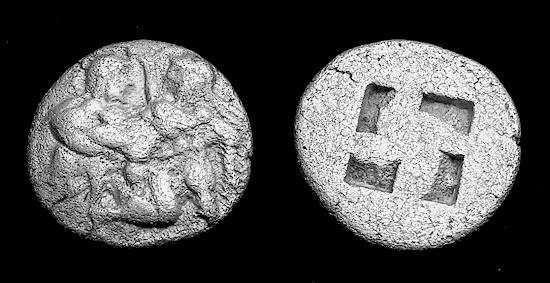
#11637: SILVER Stater
- Historical Context:
This coin was minted in Thasos ( Obv: SATYR raping a NYMPH.
The nymph raises her hand in protest.
SOLD
$429 plus shipping
|
|
|
|
||
 |
#11117: SILVER Drachm
- Historical Context: See above Obv: SATYR raping a NYMPH.
The nymph raises her hand in protest.
SOLD
$149 plus shipping
|
|
 |
#11879: SILVER TETRADRACHM - 310 BC, Minted by Ptolemy as Satrap of Egypt Historical Context: The Ptolemaic empire was founded by Ptolemy I after the death of Alexander the Great. Ptolemy I was a boyhood friend of Alexander and his most trusted general. After Ptolemy successfully completed the Persian war, Alexander granted him the area of Egypt. He founded an empire that lasted almost 300 years. The empire ended with Cleopatra VII, the Queen of the Nile. This coin was minted shortly after Alexander's death and before Ptolemy assumed the reign as King (Pharaoh) of Egypt. Obv: Alexander the Great in Elephant Skin Cap SOLD $1595 plus shipping
|
|
 (Double click for enlarged photo) |
#11880: SILVER Tetradrachm-320 BC, Macedonian Empire - Alexander the Great
Wearing the Horn of Ammon !! Historical Context: See above Obv: Alexander the Great as
Ammon (Egyptian deity) BUY NOW $799 plus shipping |
|
|
|
||
|
|
||
|
(Double click for enlarged photo) |
#11734: SILVER STATER - 272 to 235 BC, TARAS RIDING DOLPHIN !! Great Toning !! Historical Context: This coin was minted in Taretum after 307 BC. Taras (Taretum) was the most important Greek city in southern Italy during the 5th and 4th Centuries BC. Taras finally surrendered to the Romans in 272 BC. Obv: Young on Horseback
BUY NOW
$399 plus shipping
|
|
|
|
||
 |
#11873: SILVER STATER - 272 to 235 BC, TARAS RIDING DOLPHIN !! Great Toning !! ex-CNG Historical Context: This coin was minted in Taretum after 307 BC. Taras (Taretum) was the most important Greek city in southern Italy during the 5th and 4th Centuries BC. Taras finally surrendered to the Romans in 272 BC. Obv: Young on Horseback BUY NOW $449 plus shipping
|
|
|
|
||
 |
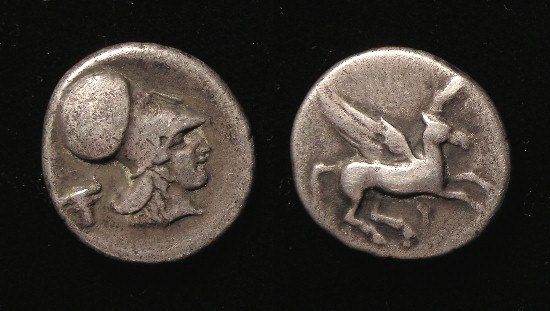
#11777: SILVER STATER - 370 BC, Corinthia, PEGASUS FLYING !! SHARP !! Historical Context: See above Obv: Pegasus SOLD
$569 plus shipping
|
|
|
|
||
(Double click for enlarged photo) |
#9415: SILVER STATER - 370 BC, Corinthia, PEGASUS FLYING !! SHARP !! Historical Context: See above Obv: Pegasus SOLD $269 plus shipping
|
|
|
|
||
 |
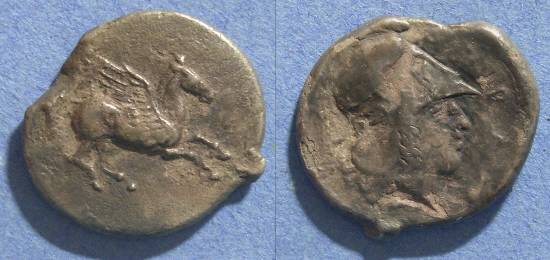
#11668: BRONZE COIN - 4th Cent BC, Corinthia, PEGASUS FLYING Good, Budget Coin Historical Context: See above Obv: Pegasus SOLD $69.95 plus shipping
|
|
 |
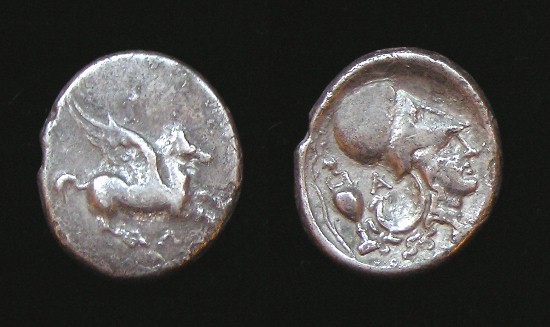
#10815: SILVER STATER - 350 BC, Syracuse, PEGASUS BUDGET PRICE Historical Context: See above Obv: Pegasus BUY NOW $229 plus shipping
|
|
|
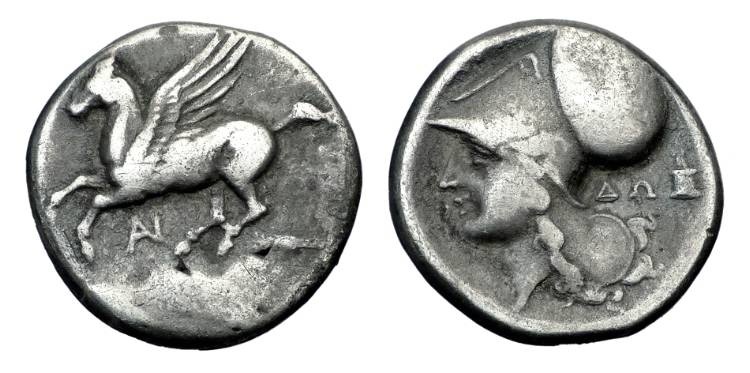
#9754: SILVER STATER - 350 BC, Akarnania (Leukas), PEGASUS FLYING !! Historical Context: See above Obv: Pegasus BUY NOW $219 plus shipping
|
|
 |
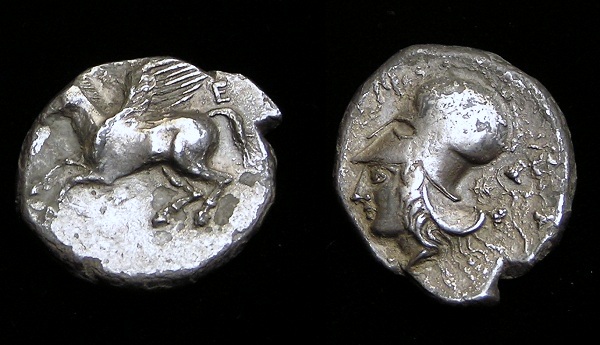
#11091: SILVER STATER - 350 BC, Akarnania (Leukas), PEGASUS FLYING !! Historical Context: See above Obv: Pegasus SOLD $339 plus shipping
|
|
|
|
||
 |
#11113: SILVER STATER - 350 BC, Akarnania (Leukas), PEGASUS FLYING !! Historical Context: See above Obv: Pegasus BUY NOW $219 plus shipping
|
|
 |
#11746: SILVER STATER - 350 BC, Illyria (Dyrrhachium), PEGASUS FLYING !! Historical Context: See above Obv: Pegasus SOLD $299 plus shipping
|
|
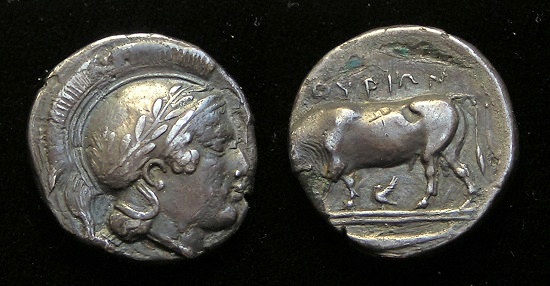 |
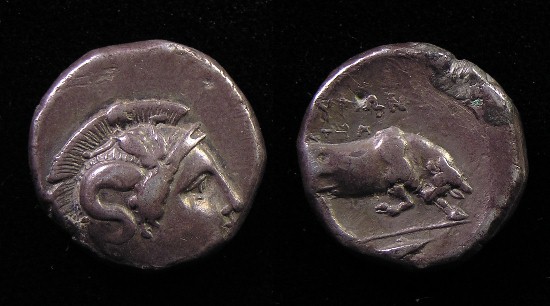
#11209: SILVER STATER - 443 to 400 BC, Thourioi Super Nice Obverse - High Style Historical Context: Thourioi
was an Athenian colony in 443 BC.
It was located in southern most region of Lucania ( Obv: Athena in Helmet BUY
NOW $399 plus shipping
|
|
(Double click for enlarged photo) |
#8571: SILVER STATER - 350 to 281 BC, Thourioi Historical Context: Thourioi
was an Athenian colony in 443 BC.
It was located in southern most region of Lucania ( Obv: Athena, Skylla (Sea Monster) on Helmet throwing Stones BUY
NOW $169 plus shipping
|
|
|
|
||
|
|
|
|
|
|
||
|
|
||
 |
#11653: SILVER Tetradrachm-320 BC, Macedonian Empire - Alexander the Great
Wearing the Horn of Ammon !! Historical Context: See above Obv: Alexander the Great as
Ammon (Egyptian deity) SOLD $899 plus shipping
|
|
 |
#11721: SILVER Tetradrachm-320 BC, Macedonian Empire - Alexander the Great
Wearing the Horn of Ammon !! Historical Context: See above Obv: Alexander the Great as
Ammon (Egyptian deity) SOLD $899 plus shipping
|
|
|
(Double click for enlarged photo) |
#11419: SILVER
Tetradrachm - 310 BC, Macedonian Empire - Alexander the Great in LION
SKIN !! Phoenician MINT !! Historical Context: See above Obv: Alexander the Great as Herakles (Hercules). He is wearing a Lion Skin. The Lion Skin is from
the Nemeaen Lion killed by Hercules with his bare hands. SOLD $439 plus shipping
|
|
 |
#11546: SILVER
Tetradrachm-310 BC, Macedonian Empire - Alexander the Great in LION
SKIN !!
BABYLON MINT !! Obv: Alexander the Great as Herakles (Hercules). He is wearing a Lion Skin. The Lion Skin is from
the Nemeaen Lion killed by Hercules with his bare hands. SOLD $599 plus shipping
|
|
 |
#11579: SILVER
Tetradrachm - 310 BC, Macedonian Empire - Alexander the Great in LION
SKIN !! MILETOS MINT !! Historical Context: See above Obv: Alexander the Great as Herakles (Hercules). He is wearing a Lion Skin. The Lion Skin is from
the Nemeaen Lion killed by Hercules with his bare hands. BUY NOW $595 plus shipping
|
|
 |
#11396: SILVER Tetradrachm-320 BC, Macedonian Empire -
Philip III, Bother of Alexander the Great in LION
SKIN !! Historical Context: This coin was minted by the MACEDONIAN EMPIRE some the after the death of Alexander the Great, around 320-300 BC. The Macedonian empire was founded by Alexander I but carried forward by others including Philip II (Father of Alexander the Great) and ALEXANDER the GREAT. Philip II developed the army and tactics that enabled Alexander the Great to accomplish his victories. Alexander the Great is considered the greatest military general ever. After Alexander's death, his bother retained power in Macedonia and minted these coins, similar to those minted in Alexander's name. Obv: Alexander the Great as Herakles (Hercules). He is wearing a Lion Skin. The Lion Skin is from
the Nemeaen Lion killed by Hercules with his bare hands. BUY NOW $349 plus shipping
|
|
 |
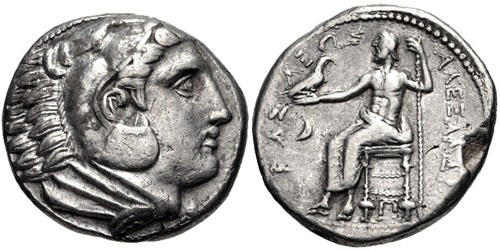
#11587: SILVER
Tetradrachm - 310 BC, Macedonian Empire - Alexander the Great in LION
SKIN !! BABYLON MINT !! Historical Context: See above Obv: Alexander the Great as Herakles (Hercules). He is wearing a Lion Skin. The Lion Skin is from
the Nemeaen Lion killed by Hercules with his bare hands. SOLD $1595 plus shipping
|
|
 |
#10828: SILVER
Tetradrachm - 320-315 BC, Macedonian Empire - Alexander the Great in LION
SKIN !! Obv: Alexander the Great as Herakles (Hercules). He is wearing a Lion Skin. The Lion Skin is from
the Nemeaen Lion killed by Hercules with his bare hands. BUY NOW $349 plus shipping
|
|
| See More Tetradrachms of Alexander the Great on the page for Alexander the Great | ||
 |
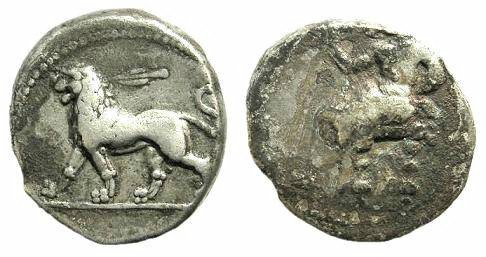
#11463: GREEK COIN - 320 BC, Alexander the Great !!
(His Face) !! w/ HERCULES' CLUB !!
Alexander, and his successors also minted bronze coins. Most of these bronze coins are about 16 to 19 mm diameter (about the diameter of a US Penny and typically twice as thick). Like his tetradrachms, most of Alexander's bronze coins feature Alexander's portrait as Herakles (same as Roman Hercules). He is wearing a Lion Skin. The Lion Skin is from the Nemeaen Lion killed by Herakles with his bare hands. The reverse scene is typically the club and/or the bow case of Herakles and a legend bearing his name in Greek.
Diameter: 17 mm diameter (about the size of a US Dime but
twice as thick) SOLD $39.95 plus shipping
|
|
 |
#9909: SILVER Tetradrachm-320 BC BABYLON !! After the Conquest by Alexander the Great Historical Context: This
coin was minted in Obv: Baal Seated SOLD $219 plus shipping
|
|
|
|
||
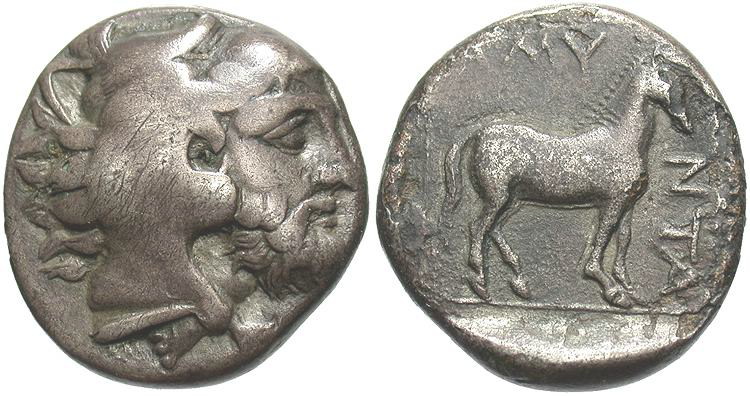 |
#10246: SILVER Stater- 393 to 370 BC Reign of Amyntas III ex Wayne Sayles Historical Context: This coin was minted byu the Macedonia Empire during the reign of Amyntas III (393 to 370 BC). Amyntas III was the son of Arrhidaeus and father of Philip II, was king of Macedon in 393 BC, and again from 392 to 370 BC. He came to the throne after the ten years of confusion which followed the death of Archelaus I, the patron of art and literature. But he had many enemies at home; in 393 he was driven out by the Illyrians, but in the following year, with the aid of the Thessalians, he recovered his kingdom. Medius, head of the house of the Aleuadae of Larissa, is believed to have provided aid to Amyntas in recovering his throne. The mutual relations between the Argeadae and the Aleuadae dates to the time of Archelaus I. Note: The coin may be a fourrie, meaning it has a copper core. However, that is not certain. The coin does weight the correct weight standard and the exposed core looks like it may be crystalized silver (as expected for the standard issue), not copper. Obv: Mature Herakles SOLD $579 plus shipping
|
|
|
(Double click for enlarged photo) |
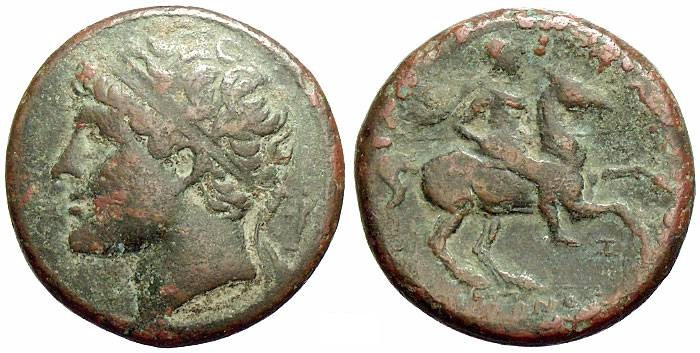
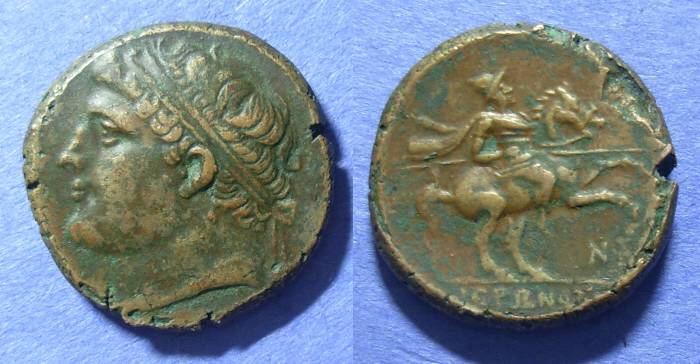
#9577: LARGE Bronze (AE28) of SYRACUSE - 250 BC,
Heiron II / Him on Horseback
Historical Context: This coin was minted in SYRACUSE, SICILY during the reign of HIERON II (275-215 BC). This wise and popular ruler was the first Greek tyrant to openly place his image on coins of the realm. Rising from a humble beginning in Phthia, Hieron became the leader of the army and married the beautiful aristocrat Philistis. He was acknowledged as King of Syracuse by the will of the people and lead a successful era in Syracusian politics. Obv: Hieron II SOLD $199 plus shipping
|
|
 |
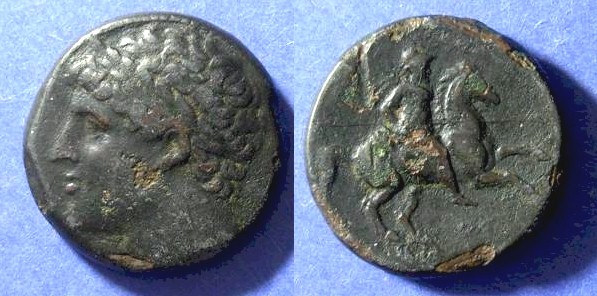
#11029: LARGE Bronze (AE28) of SYRACUSE - 250 BC,
Heiron II / Him on Horseback
Historical Context: See above Obv: Hieron II BUY NOW $219 plus shipping
|
|
 |
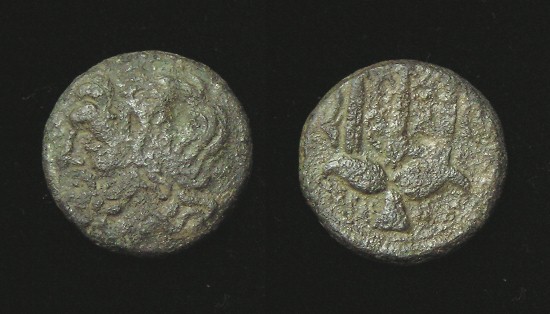
#9814: LARGE Bronze (AE28) of SYRACUSE - 250 BC,
Heiron II / Him on Horseback
Historical Context: See above Obv: Hieron II BUY NOW $159 plus shipping
|
|
 |
#9868: Bronze (AE18) of SYRACUSE - 250 BC, Heiron II Historical Context: See above Obv: Poseidon BUY NOW $39.95 plus shipping
|
|
 |
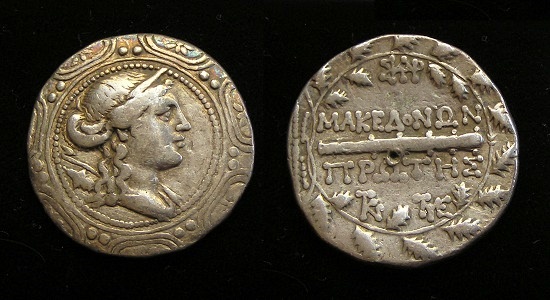
#11732: SILVER 16 Litrae of SYRACUSE - 250 BC,
Reign of Heiron II Queen Philistis, Beautiful wife of Hieron II Historical Context: This coin was minted in SYRACUSE, SICILY during the reign of HIERON II (275-215 BC). This wise and popular ruler was the first Greek tyrant to openly place his image on coins of the realm. Rising from a humble beginning in Phthia, Hieron became the leader of the army and married the beautiful aristocrat Philistis. He was acknowledged as King of Syracuse by the will of the people and lead a successful era in Syracusian politics. Obv: Queen Philistis SOLD $1,199 plus shipping |
|
 |
#10659:
SILVER Tetradrachm - 155 BC, Artemis-Goddess of
the HUNT ! NICE TONING !!!!! Historical Context: This coin was minted by the MACEDONIAN Empire in THESSALONIKA (Northern Greece) under ROMAN RULE between 158-149 BC. This city was called THERMA in an earlier period but received its more famous name in 315 BC in honor of Kassander’s (Greek ruler) wife Thessalonika the daughter of PHILIP II and sister to ALEXANDER the GREAT. This was during the period known as the ROMAN REPUBLIC. After the fall of the monarchy, it became the capital of the second republic established by the Romans. This is a period in which the Romans were just gaining their power. Obv: MACEDONIAN SHIELD. At the center of
the shield is ARTEMIS, GODDESS of the HUNT and
GODDESS of the MOON SOLD $369 plus shipping
|
|
|
|
||
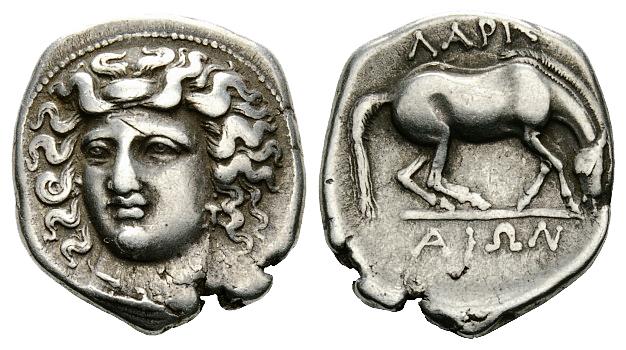 |
#11266:
SILVER Drachm - LARISSA - 344 to 321 BC, Nymph Larissa, 3/4s Facing Historical Context: This coin was minted in LARISSA, THESSALY around 344 to321 BC. Thessaly was located in Central Greece on the western shore of the Aegaen Sea. It was a vast plain, surrounded by mountains with a river, River Peneios, running through it. Thessaly was famed in its day for its fine horses and horseman. Thus, the coinage of Thessaly was often included an equestrian motif. Obv: Nymph Larissa, 3/4s Facing SOLD $599 plus shipping
|
|
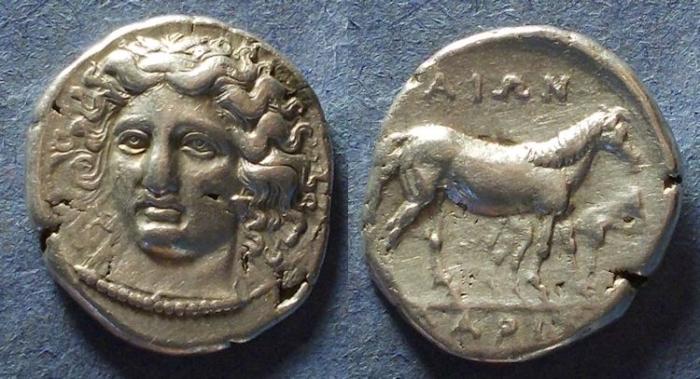 |
#11261:
SILVER Drachm - LARISSA - 344 to 321 BC, Nymph Larissa, 3/4s Facing Historical Context: See above. Obv: Nymph Larissa, 3/4s Facing BUY NOW $569 plus shipping
|
|
 |
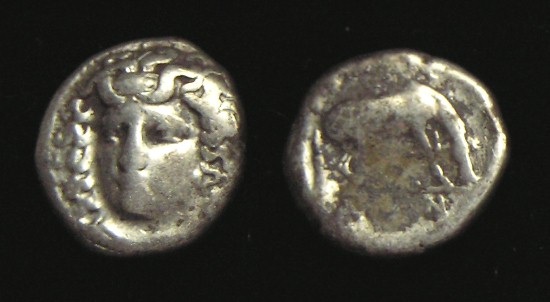
#11457:
SILVER Drachm - LARISSA - 344 to 321 BC, Nymph Larissa, 3/4s Facing Historical Context: See above. Obv: Nymph Larissa, 3/4s Facing SOLD $319 plus shipping
|
|
|
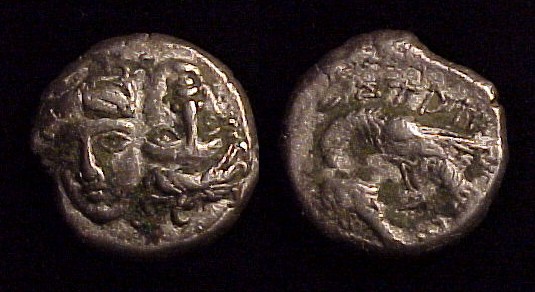
#9584:
SILVER Drachm - LARISSA - 344 to 321 BC, Nymph Larissa, 3/4s Facing Historical Context: See above. Obv: Nymph Larissa, 3/4s Facing BUY NOW $169 plus shipping
|
|
|
|
||
(Double click for enlarged photo)
|
#4698:
SILVER Drachm - ISTROS - 400 to 350 BC, Twin Inverted
Heads!!
Historical Context: This coin was minted in ISTROS: was located in Thrace (Northern Greece) on the coastline of the Black Sea. There was a large amount of silver coinage issued in the frist half of the 4th Century BC suggesting it was a place of commercial importance. The Twin Inverted Faces is one of the most collectable of ancient coins. The inverted faces has been interpreted to represent the Dioskouri, the rising and setting sun. Obv: Twin Faces, Inverted BUY NOW $139 plus shipping
|
|
|
|
||
|
|
||
|
|
||
|
|
||
|
|
#8843:
Silver Stater: Metapontion 5th to 4th Century BC, Demeter - Goddess of the Grain Harvest !! Historical Context:
Metapontion
was a region (city) located the eastern coast of Lucania
(across from Obv: Demeter
(Hair wreathed with grain) SOLD $149 plus shipping
|
|
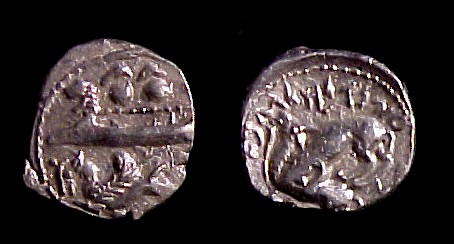
(Double click for enlarged photo) |
#4339: Byblos / PHOENICIA – 350 to 330 BC, Hoplites, Hippocamp / Lion Attacking Bull 1/8th Shekel Historical Context: These coins were minted in BYBLOS, (on Phoenician coast, about midway) during the 4th century BC. Phoenicia was a the coastal area just north of Palestine. It contained numerous important trade and port cities., including Byblos. Byblos (also known as Gebal, was a center of worship for Adonis. Obv: Galley with Three Hoplites,
Hippocamp below SOLD $59.95 plus shipping
|
|
|
|
||
|
|
||
|
Go to ==>>
|
Pay for your purchase by credit cards, personal check, or money
orders
|
|
|
Contact Us:
MuseumSurplus.com
|
||
|
|
Content Copyright 2000, MuseumSurplus.com (Ken Martins)
Source code and object code
Copyright 1998, Primecom Interactive, Inc.
Subject to terms of license agreement.


 AND
AND